A test to take care of you and your baby from the very start

MaiRa is the first test on the market that allows the risk of preeclampsia to be assessed from week 9 of pregnancy

Committed to health during pregnancy

Pioneers in the early detection of gestational diseases
Our vision is a world in which every pregnancy is experienced with peace of mind and confidence, without fear for the health of the mother or the baby.

Taking care of you so you can take care of them

MaiRa is the first test on the market that allows the risk of preeclampsia to be assessed from a blood sample, in very early stages of pregnancy.

  • From week 9
  • Early and personalised information
  • Support for medical monitoring during pregnancy

Taking care of you

Caring for your baby

Preeclampsia is a pregnancy complication that can appear without symptoms in its early stages and affect both the mother and the baby.

1 in every 20 pregnancies

may develop preeclampsia

76,000 mothers

die each year worldwide from associated complications

500,000 babies

die annually from related causes

Detecting the risk early makes it possible to act before complications appear.

Our science to care for what matters most

Information that allows you to make decisions and act in time, with scientific evidence to care for you and your baby

Developed by experts in maternal-fetal health

Based on scientific evidence

Clinically and scientifically validated

Designed to support medical decisions

What do we do at iPremom?

iPremom  was created to care for mothers and their babies, offering solutions that make it possible to anticipate and support pregnancy with greater peace of mind and safety.

Are you looking for information for yourself or for your clinical practice?

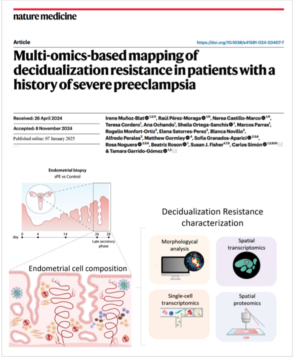
A groundbreaking study reveals key mechanisms underlying pre-eclampsia and opens up new avenues for its prevention and treatment
A study led by Dr Tamara Garrido, recently published in the journal *Nature Medicine*, has made significant progress in our understanding of preeclampsia.
This study represents a significant step forward in our understanding of pregnancy complications and offers new insights into improving their management and reproductive health outcomes.
 
Read the full study here
Advanced technologies reveal ‘resistance to decidualisation’
Using cutting-edge technologies, such as the digital tissue analysis, la single-cell sequencing and the space biology, the multidisciplinary team characterised a condition which they termed “resistance to decidualisation”.
This change affects the optimal preparation of the endometrium for embryo implantation and placental development, and probably plays a key role in the onset of pre-eclampsia. pre-eclampsia.
 
A multi-omic map of the endometrium
Through an approach multi-omic, the researchers produced a detailed cellular map of the endometrium.
The study identified changes in glandular morphology from the endometrial tissue of women with pre-eclampsia.
At the level of single cell, the analysis revealed the presence of cells endometrial stromal and epithelial cells with a proliferative phenotype, coexisting with the decidualised phenotype expected in patients with pre-eclampsia.
 
Wider implications for gynaecological health
The findings go beyond pre-eclampsia and offer new insights into other reproductive and gynaecological conditions, such as endometriosis, in which the processes of decidualisation are also disrupted.
“This multi-omic map of the endometrium paves the way for the development of personalised treatments, not only for pre-eclampsia, but also for a wide range of uterine disorders,” says Dr Garrido.